
First Seen
2024-04-02T06:49:01.847719+00:00
gemma3-27b-vision
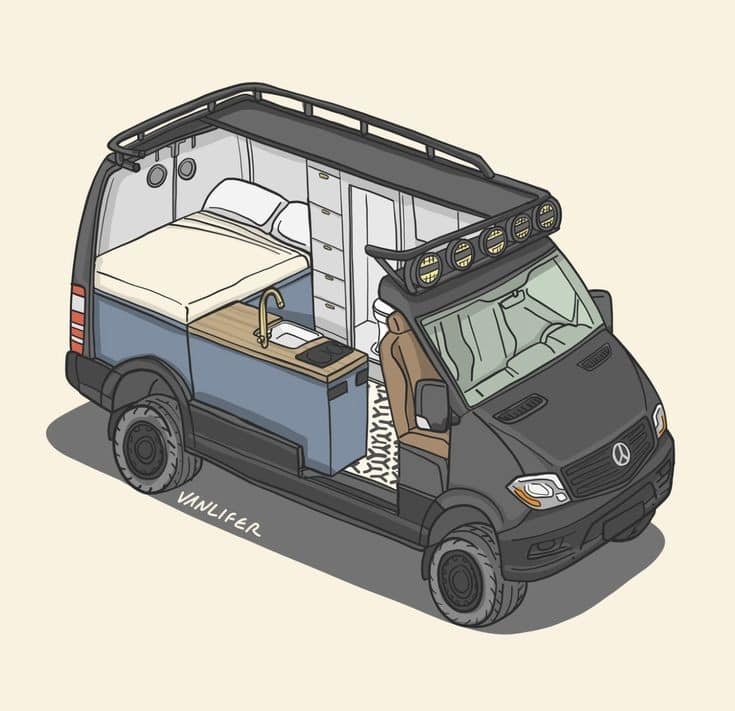
Okay, here's an analysis of the image, broken down into the requested sections. Not all sections will be relevant, and the depth of analysis will vary based on the applicability to the image. **Visual Description** The image presents a digitally drawn, isometric view of a converted van, likely a Mercedes Sprinter. The van is dark gray with a blue lower section, and appears to be outfitted for “van life” - a lifestyle of minimalist living and travel from a vehicle. The interior is visible, revealing a simple, wooden-paneled build-out. We can see a kitchenette with a sink and counter space, a bed platform, and some storage areas. There's a roof rack with what appear to be extra containers and a light bar above the cab. The tires are thick and rugged, suggesting off-road capability. The image is rendered in a cartoonish style with a simple color palette, and has a signature on the lower left which reads "VANLIFEr". Overall, it conveys a sense of freedom, simplicity, and adventure. --- **Foucauldian Genealogical Discourse Analysis** This image, and the 'van life' phenomenon it represents, is rich for a Foucauldian analysis. The discourse of ‘van life’ is relatively recent, emerging and solidifying in the last decade through social media platforms like Instagram and YouTube. * **Power/Knowledge:** The image isn't simply about a vehicle; it represents a carefully curated *style of life* presented as a form of liberation. However, that liberation is *produced* by specific discourses and technologies. Social media (Instagram, YouTube) become technologies of power/knowledge, shaping what constitutes a desirable lifestyle and normalizing the idea of "escaping" societal norms through consumption (the van, the build-out materials, travel). The discourse frames "living in a van" as a rejection of traditional markers of success (homeownership, careers), but paradoxically, it’s built on the ability to *afford* a van, the time to travel, and the technology to document and broadcast that lifestyle. * **Genealogy of "Escape":** A genealogical investigation would examine how the idea of "escaping" societal constraints has evolved. The image taps into a long history of romanticizing nomadic existence (think Thoreau's *Walden*, Beat Generation road trips), but reframes it for a consumerist age. It’s not a rejection of society, but a *selective* engagement with it, choosing to live *differently* while still participating in the digital economy. * **Disciplinary Power:** The need to document and curate a perfect "van life" on social media also illustrates a form of disciplinary power. Individuals are internalizing the norms of the digital sphere, shaping their behavior (and their van build) to conform to expectations and achieve "likes" and validation. --- **Critical Theory** From a Critical Theory perspective, this image serves as a symbol of the contradictions within late-stage capitalism. * **Commodification of Freedom:** The image represents a yearning for freedom and authenticity, yet this yearning is *expressed through* and *mediated by* the market. The van itself is a commodity. The build-out materials are commodities. Even the lifestyle of "getting away from it all" is often fueled by the pursuit of experiences, which are also commodified. * **False Consciousness:** The aesthetic of simplicity and minimalism can mask the underlying economic forces at play. The image presents a potentially romanticized view of a life free from societal pressures, but it doesn't address systemic issues like economic inequality, housing crises, or environmental sustainability. It can foster a sense of individual "solution" to problems that require collective action. * **Spectacle and Simulation:** The curated, Instagram-friendly aesthetic of the van contributes to the "spectacle" (Debord) of modern life. The image isn’t about *living* a simpler life, but *presenting* a simpler life to others. It is a simulation of authenticity. --- **Marxist Conflict Theory** From a Marxist perspective, the van life phenomenon, as depicted in this image, can be understood through the lens of class conflict and the commodification of leisure. * **Class Privilege:** The ability to afford a van, convert it, and travel freely represents a level of economic privilege inaccessible to many. It highlights the disparity between those who have the resources to escape the pressures of capitalist society and those who are trapped within it. * **Commodification of Escapism:** "Van life" becomes a commodity itself, marketed and sold to a niche demographic. Companies capitalize on the desire for freedom and adventure by selling vans, conversion kits, and travel accessories. * **Labor and Leisure:** The image masks the underlying labor that enables this leisure. The production of the van, the materials used in the conversion, and the infrastructure supporting travel all rely on the exploitation of labor within the capitalist system. --- **Postmodernism** The image embodies several key tenets of postmodernism. * **Pastiche and Simulation:** The van’s interior, a mix of rustic wood and modern technology, represents a pastiche of styles. It's not an authentic representation of any particular tradition, but a blend of influences. As discussed above, the lifestyle itself can be seen as a simulation of authenticity. * **Deconstruction of Norms:** The image challenges conventional notions of home and lifestyle. It rejects the idea that happiness is tied to material possessions or a fixed location. * **Fragmentation and Subjectivity:** "Van life" is often presented as a highly individualized and subjective experience. There's no single "right" way to do it, and individuals are encouraged to create their own unique expression of this lifestyle. * **The Hyperreal:** The constant documentation and sharing of "van life" on social media creates a hyperreal version of reality—an image that is more "real" than real itself. --- **Queer Feminist Intersectional Analysis** While not immediately obvious, a Queer Feminist Intersectional analysis can offer interesting insights. * **Challenging Heteronormative Space:** The idea of escaping societal norms through “van life” can be linked to a desire to create alternative spaces, potentially outside of the traditional constraints of family, marriage, and homeownership – all deeply intertwined with heteronormative expectations. It provides a space for those who don’t fit into conventional models of life. * **Mobility and Freedom:** For marginalized groups (including queer individuals, people of color, and people with disabilities), mobility can be a crucial form of resistance and empowerment. "Van life" offers a potential path to liberation from restrictive environments and discriminatory practices. * **Intersectionality of Privilege:** It's vital to recognize that access to "van life" is not equally available to everyone. Factors like race, gender, class, and disability intersect to create barriers to entry. The image doesn’t necessarily reflect the diversity of experiences within the “van life” community. * **Critique of the "Escape" Narrative:** The idea of “escaping” society can be problematic if it ignores the systemic inequalities that create those conditions in the first place. Queer and feminist perspectives highlight the importance of *transforming* society, rather than simply withdrawing from it. I hope this comprehensive analysis is helpful! Let me know if you'd like me to elaborate on any specific aspect or lens.
tesseract-ocr
ae A. = ( 4) <a ——
llama3.2-vision
The meme is an illustration of a van with a living space inside, featuring a bed, kitchen, and chair. The van is labeled "VANLIFER" and has a large window on the side. The image is likely meant to be humorous or ironic, as it's unlikely that a van would be able to fit all of these features in its interior.