First Seen
2025-05-13T07:37:23.658107+00:00
simple-description (qwen3.5_2b-q8_0)
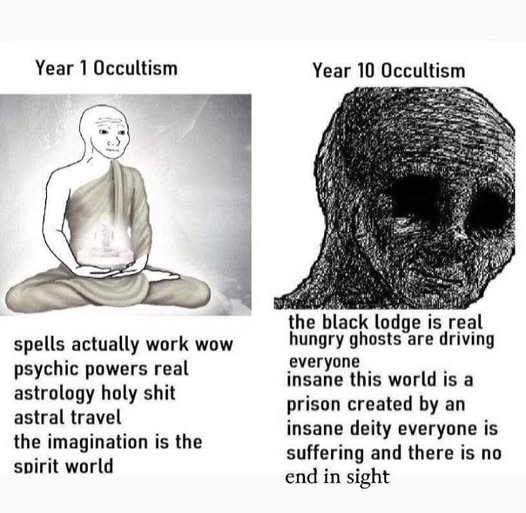
This meme contrasts the enthusiastic, naive early stages of witchcraft with the disillusioned, dark reality that practitioners eventually face.
On the left, titled "Year 1 Occultism," it shows a peaceful figure believing in "spells actually work," "psychic powers," and that the imagination is the true spirit world.
On the right, titled "Year 10 Occultism," it uses a horror-faced figure to depict the cynicism and despair, mentioning that real "hungry ghosts" are driving people insane and that the world is a "prison created by an insane deity."
detailed-analysis (gemma3_27b-it-q8_0)
Okay, let's break down this meme through the lens of witchcraft and the requested theoretical frameworks. This is going to be a detailed analysis, so it's a bit lengthy!
Understanding the Meme's Core Argument
The meme presents a stark contrast between a naïve, beginning stage of witchcraft (Year 1) and a profoundly disillusioned and potentially dark stage (Year 10). It's a commentary on the shift in perspective that can occur as someone delves deeper into occult practices. The journey begins with empowerment and wonder, then descends into a sense of cosmic horror, entrapment, and helplessness.
Visual Description
The visual dichotomy is crucial.
- Year 1: Uses the "Wojak" meme format, particularly the "NPC" or "Virgin" variant. This image depicts a simple, slightly blank-faced figure in a meditative pose, wearing robes and holding a book. This conveys innocence, a beginner's purity, and a willingness to readily accept easily-available information. The posture suggests an inward focus and a positive expectation.
- Year 10: Depicts a distorted, monstrous face, rendered in a dark and unsettling style. The hollow eyes and monstrous features symbolize a corruption of the initial vision, a confronting of darker realities, and a loss of innocence. This image evokes fear and a sense of being overwhelmed by something sinister.
The stark contrast in style immediately communicates the dramatic change in worldview the meme aims to portray.
Foucauldian Genealogical Discourse Analysis
Michel Foucault's genealogical method traces the historical development of concepts, power structures, and knowledge systems. Applied here, we can see how the meme reflects the shifting discourses surrounding witchcraft:
- Initial Discourse (Year 1): This is largely shaped by contemporary "New Age" or popularized witchcraft, often characterized by individual empowerment, positive thinking, and accessible information. This discourse relies on the idea that spells work through personal energy and intention, and the spirit world is benevolent or neutral. It’s a relatively "clean" discourse, with accessible narratives.
- Mature Discourse (Year 10): The shift to "the Black Lodge is real" and "hungry ghosts" represents a descent into older, more complex, and often darker traditions. This aligns with a rejection of superficial, commodified spirituality. It taps into concepts like gnosticism, chaos magic, and more intense occult practices that don’t offer easy answers. This discourse acknowledges a chaotic, potentially hostile cosmic order.
- Power/Knowledge: Foucault argued knowledge is always tied to power. The meme suggests that as someone gains knowledge through prolonged practice, the power dynamic shifts. No longer is the practitioner in control, but instead subject to forces beyond comprehension. This also reveals the power dynamics inherent in different traditions of magic - some empower the individual, while others emphasize submission to greater forces.
The meme reveals a power shift in understanding, from a discourse of personal empowerment to one of confronting overwhelming, uncontrollable forces.
Critical Theory (Frankfurt School)
From a critical theory perspective, the meme highlights the potential for “enlightenment” (deeper occult knowledge) to turn into its opposite – a state of disempowerment and existential dread.
- Reason and Myth: The initial stage represents a rationalized, simplified version of the occult. It’s accessible and feels “reasonable” within a modern framework. The later stage embodies the return of myth, the irrational, and the anxieties suppressed by Enlightenment rationality.
- Culture Industry: The initial image can be seen as a product of the "culture industry" – the commodification and simplification of esoteric knowledge for mass consumption. The later stage suggests a rejection of this superficiality and a confrontation with the "authentic" (though terrifying) reality underlying the surface.
- Alienation: The sense of being trapped in a prison created by an insane deity reflects a core concept of critical theory: alienation. The individual is alienated from their own power, from the natural world, and from any sense of meaning or purpose.
Postmodernism
The meme embodies key postmodern ideas:
- Rejection of Grand Narratives: The initial "spells actually work" narrative is a simplified, hopeful “grand narrative.” The Year 10 image deconstructs this, revealing a reality that resists easy explanation. There is no single truth, no neat story, only fragmented experiences and conflicting forces.
- Simulacra and Simulation: The early stages of witchcraft may be viewed as a “simulation” – a constructed reality based on wishful thinking and superficial understanding. The deeper dive exposes the “real” – a chaotic, unsettling realm that exists beyond the simulation.
- Deconstruction of Authority: The meme implicitly challenges the authority of any single magical tradition. It suggests that prolonged exploration leads to skepticism and the realization that all systems of belief are ultimately provisional and inadequate.
The Absence of Queer Feminist Intersectional Analysis (and why it matters)
While the meme could be analyzed through this lens, it's notably lacking in explicit engagement with these issues. This is itself telling. Traditional witchcraft (and especially the popularized versions it critiques) often has a history of excluding or marginalizing queer and feminist voices.
- Historical Exclusion: Historically, witchcraft accusations were often used to persecute women, particularly those who defied social norms. Queer individuals have also faced similar persecution. The meme's descent into darkness could be interpreted as mirroring this historical trauma.
- Patriarchal Deities: The "insane deity" framing might implicitly perpetuate patriarchal structures if the deity is traditionally male. A feminist analysis would question the power dynamics involved and explore alternative, more empowering representations of the divine.
- Intersectional Considerations: The meme's focus on individual existential dread overlooks the ways in which these experiences are shaped by race, class, and other social factors. A truly intersectional analysis would examine how different identities intersect to create unique experiences of oppression and liberation within the occult world.
The lack of explicit engagement with these issues highlights the need for a more inclusive and critically aware approach to witchcraft. It's not that these perspectives can't be applied, but the meme doesn't inherently prompt them.
In conclusion:
This meme is a layered piece of internet commentary that speaks to the disillusionment and potentially unsettling truths that can emerge through prolonged occult practice. It's a critique of popularized witchcraft, a reflection of the anxieties of modernity, and a warning about the dangers of seeking power without understanding the responsibility that comes with it. It provides ample fodder for analysis through several theoretical frameworks, revealing the complexities and contradictions inherent in the pursuit of esoteric knowledge.
simple-description (llama3.2-vision_11b)
This meme is a humorous comparison of the typical expectations of a witch or occultist in the past (left) versus a modern-day occultist (right). The left image depicts a serene, mystical figure surrounded by candles and symbols, while the right image shows a person surrounded by darkness and chaos. The text on the left reads: "Year 1 Occultism: Spells, Astral Travel, Divination, Mysticism" and on the right: "Year 10 Occultism: Abandoning All Hope, Eating Rats, Living in a Damp Basement".
detailed-analysis (gemma3-27b-vision)
Okay, here's an analysis of the meme, broken down into the sections you requested, focusing on where those theories meaningfully apply. Given the content, several sections will be more developed than others.
Visual Description
The meme is a two-panel comparison.
- Panel 1 ("Year 1 Occultism"): Depicts a Wojak-style character (a crudely drawn, often used online meme figure to represent a person) in a lotus position, appearing serene, with a slightly vacant, naive expression. The background is a soft, indistinct garden. The character is meant to represent a beginner or novice.
- Panel 2 ("Year 10 Occultism"): Depicts a drastically altered Wojak, resembling a dark, amorphous, vaguely monstrous face with large, hollow eyes. The background is a void. The image is dark and conveys a sense of dread or horror. It's meant to represent someone deeply immersed in occult practices over a long period.
The contrast between the two panels is stark, emphasizing a shift in perception or experience.
Foucauldian Genealogical Discourse Analysis
This is perhaps the most directly relevant theoretical framework. The meme implies a genealogy of occult knowledge – a tracing of its historical development and the shifting power/knowledge relations within it.
- Initial Discourse: "Year 1" represents a discourse centered on empowerment, self-discovery, and positive manifestation. The pronouncements ("spells actually work," "psychic powers real") construct a reality where the individual can exert control through occult practices. This is a discourse that promises knowledge and agency.
- Shifting Discourse: "Year 10" embodies a discourse of disempowerment and cosmic horror. It reveals that the 'truths' accessed are not empowering, but terrifying. This challenges the initial assumption of agency and suggests that knowledge does not necessarily equal liberation.
- Power/Knowledge: The meme highlights how occult knowledge isn't neutral. The knowledge changes the perceiver, but also reveals a darker, more unsettling reality. This aligns with Foucault's concept that power and knowledge are inextricably linked – and that knowledge itself is a form of power. The initial discourse constructs a reality of agency, while the later discourse reveals a reality where agency is an illusion.
- Episteme: The shift could be seen as a change in the "episteme" – the underlying system of thought and knowledge that governs a particular era. "Year 1" represents a more optimistic, self-centered episteme, while "Year 10" represents a darker, more nihilistic one.
Critical Theory
The meme engages with themes central to Critical Theory, specifically related to ideology and disillusionment.
- Initial Ideology: The "Year 1" panel can be seen as a reflection of a certain idealistic ideology around occultism – a belief in self-improvement, control over one's destiny, and the potential for positive transformation.
- Ideological Critique: "Year 10" functions as a critique of this initial ideology. It suggests that the "positive" beliefs are a form of self-deception. The horrors revealed in the second panel dismantle the notion of a benevolent or manageable reality.
- False Consciousness: One could argue that "Year 1" represents a form of "false consciousness" - a belief system that obscures the true nature of reality and perpetuates a sense of control where none exists. "Year 10" is the awakening from that false consciousness.
- Domination: The 'insane deity' and 'hungry ghosts' can be interpreted as representing forces of domination and control. The realization that these forces exist is a revelation of the true power dynamics at play in the universe.
Postmodernism
Postmodern themes are subtly present:
- Rejection of Grand Narratives: The meme challenges the idea of a linear, progressive path of occult knowledge. There's no "master narrative" of spiritual enlightenment. Instead, it suggests a descent into chaos and meaninglessness.
- Subjectivity of Reality: The contrast between the two panels highlights the subjective nature of reality. What begins as a positive experience transforms into a terrifying one, depending on the knowledge gained. There's no objective "truth" to be discovered, only interpretations.
- Deconstruction: "Year 10" deconstructs the initial assumptions and beliefs of "Year 1". It reveals the hidden contradictions and power dynamics that underpin the seemingly positive discourse.
Marxist Conflict Theory
The application of Marxist Conflict Theory is weaker, but can be present:
- Power Imbalance: The "insane deity" and "hungry ghosts" can be seen as representing forces of oppressive power. The realization that these forces exist suggests a fundamental conflict between those who are dominated and those who dominate.
- Alienation: The "prison" metaphor suggests a state of alienation – a separation from one's true self and from a meaningful existence.
- Class Struggle (Metaphorically): One could metaphorically interpret the conflict as a class struggle – a battle between those who are trapped in the prison and those who control it.
Queer Feminist Intersectional Analysis
This is the least applicable framework, but still possible:
- Challenging Power Structures: The "insane deity" could be seen as a representation of patriarchal or oppressive power structures. The realization that these structures exist and control our lives is a key theme of feminist thought.
- Intersectionality: The idea of being "trapped" and "suffering" could be used to discuss the ways in which marginalized groups experience oppression and are denied agency. The meme suggests that this suffering is systemic and inescapable.
Important Note: This meme is inherently dark and nihilistic. Interpreting it through these frameworks doesn't necessarily endorse those views, but rather highlights how those theories can be used to unpack its meaning. The core message appears to be a disillusionment with certain forms of spirituality and a confrontation with the darker aspects of reality.
simple-description (llama3.2-vision)
The meme is a comparison between the first year of an "Occultism" (a fictional, humorous, and satirical "year" of a person's life) and the 10th year of an "Occultism" (again, a fictional, humorous, and satirical "year" of a person's life). The first year is a serene image of a person meditating, with the text "Year 1 Occultism: spells actually work, wow, psychic powers, real astrology, holy shit, astral travel, the imagination is the spirit world." The 10th year is a dark, distorted image of a person, with the text "Year 10 Occultism: the black lodge is real, hungry ghosts are driving everyone, insane this world is a prison created by an insane deity, everyone is suffering, and there is no end in sight." The meme is meant to be humorous and satirical, comparing the "mystical" and "spiritual" experiences of a person in their first year of "Occultism" to the dark, hellish, and despairing experiences of a person in their 10th year of "Occultism".