First Seen
2024-05-28T02:18:12.108917+00:00
simple-description (qwen3.5_2b-q8_0)
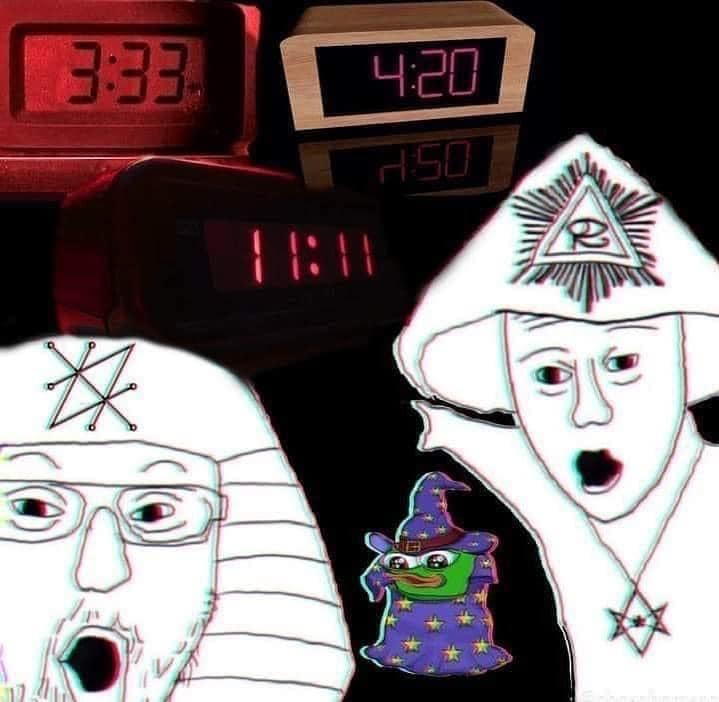
This funny image features digital clocks displaying the times 3:33, 4:20, 4:50, and 11:11, suggesting the passage of time. Superimposed over the clocks are two shocked, white-faced characters—one resembling Napoleon in an Egyptian headdress and the other a sorcerer with a pyramid eye symbol—and a small green frog dressed in a purple witch's outfit adds a whimsical touch to the scene.
simple-description (llama3.2-vision_11b)
The meme is a screenshot from the 4chan imageboard, featuring a character from the internet subculture known as "pepe" with a shocked expression. The text "I CAN SMELL THE BURNING OF THE INTERNET" appears above the image, implying that the character is reacting to the chaos and destruction of the internet. The meme is a humorous commentary on the state of online discourse and the chaos that can ensue when people with differing opinions clash.
detailed-analysis (gemma3-27b-vision)
Okay, let's break down this complex image using the requested theoretical lenses. It's a heavily layered, digitally manipulated image, steeped in internet culture and esoteric symbolism, so a thorough analysis requires navigating a lot of terrain. I'll go section by section, noting when a lens doesn't quite apply.
I. Visual Description
The image is a digitally altered composition featuring characters and motifs pulled from various internet subcultures. It uses a palette of mostly red and white.
- Characters: Two primary figures are dominant: Rick Sanchez from the animated show Rick and Morty (on the left), and Morty Smith, also from Rick and Morty. A small, digitally inserted figure of the "Pepe the Frog" meme (wearing a wizard hat) sits between them.
- Symbolism: Overlaid onto the characters and the background are various esoteric symbols: an "Eye of Providence" (all-seeing eye) within a triangle is on Morty’s hat, and several geometric patterns and star-like emblems are scattered around.
- Background: Multiple digital clock displays showing specific times (3:33, 4:20, 4:50, and 1:11) are visible in the background. These times are often associated with internet 'trigger times' or memetic significance.
- Aesthetic: The image has a glitchy, distorted, and intentionally lo-fi aesthetic. The characters appear to be rendered in a simple, flat style, with exaggerated expressions of shock and terror. There is a deliberate sense of chaos and fragmentation.
- Overall Impression: The image evokes a sense of anxiety, conspiracy, and a playful engagement with internet folklore. It is highly referential, drawing on multiple layers of pre-existing cultural content.
II. Foucauldian Genealogical Discourse Analysis
This image is extremely well-suited to a Foucauldian reading.
- Discourses & Power/Knowledge: The image is a collage of discourses. We see the discourse of popular animation (Rick and Morty), the discourse of internet memes (Pepe, 'trigger times'), and the discourse of esotericism/conspiracy theory (Eye of Providence, geometric symbols). These discourses aren’t neutral; they’re bound up with power relations. Rick and Morty itself became a site for debates about intellectualism, nihilism, and fandom, generating its own power dynamics within online communities. The appropriation of esoteric symbols speaks to a desire for 'hidden knowledge' and a rejection of mainstream authority.
- Genealogy: A genealogical approach looks at the historical formation of these discourses and their evolving meanings. The Eye of Providence, originally a Christian symbol, has been co-opted by conspiracy theories (e.g., Illuminati) over time, acquiring new and often sinister connotations. The Pepe meme, originating as a harmless webcomic character, underwent a disturbing transformation as it was embraced by alt-right groups, becoming a symbol of hate. The clock times (3:33, 4:20, etc.) originally arose from paranormal beliefs, and were adopted as triggers within the internet’s glitch subculture. The image traces the historical shifts and appropriations of these symbols, revealing how they’ve been recontextualized and imbued with new meanings.
- Power Relations: The image suggests a power imbalance. The exaggerated fear on the characters' faces implies that they are overwhelmed by the forces symbolized by the clock times and esoteric imagery. This can be interpreted as a reflection of anxieties about surveillance, control, and the overwhelming nature of information in the digital age.
- Subjectivation: The image can also be read in terms of how it shapes our understanding of ourselves and the world around us. The collage of symbols encourages a particular way of seeing reality – a reality where hidden forces are at play and where everyday objects can carry esoteric significance.
III. Critical Theory
This image readily lends itself to a Critical Theory approach.
- Ideology: The image can be seen as a fragmented representation of contemporary anxieties and ideologies. The combination of pop culture references and esoteric symbols suggests a breakdown of traditional belief systems and a search for new meaning in a chaotic world. The characters' expressions of fear suggest a sense of alienation and powerlessness in the face of these forces.
- Culture Industry: The image can be viewed as a product of the “culture industry” (Adorno & Horkheimer), which mass-produces and commodifies cultural artifacts. The image appropriates and remixes elements from popular culture ( Rick and Morty, memes) and esoteric traditions, creating a pastiche that reflects the fragmented and consumer-driven nature of contemporary society.
- Alienation: The exaggerated expressions of fear on the characters' faces, combined with the fragmented and chaotic nature of the image, suggest a sense of alienation and disconnection. This alienation can be interpreted as a result of the commodification of culture and the loss of authentic experience.
- False Consciousness: The image, while seemingly chaotic, could be seen as reinforcing a particular worldview—one that emphasizes conspiracy, paranoia, and distrust of authority. This could be interpreted as a form of “false consciousness” (Marx), where individuals are misled into accepting a distorted view of reality.
IV. Marxist Conflict Theory
While not as directly applicable as the previous lenses, elements of Marxist Conflict Theory can be teased out.
- Cultural Hegemony: The image could be seen as a disruption of cultural hegemony (Gramsci). By appropriating and remixing elements from various cultural domains, the image challenges dominant narratives and power structures.
- Commodity Fetishism: The appropriation of cultural references (Rick and Morty, Pepe) can be viewed as a form of “commodity fetishism,” where cultural objects are imbued with symbolic value and become objects of desire.
- Class Conflict: The image’s anxieties about control and surveillance could be interpreted as a reflection of class conflict, where those in power seek to control and exploit those who are less privileged. (This connection is weaker, but possible.)
- Ideological Struggle: The image can be seen as a site of ideological struggle, where different worldviews compete for dominance. The appropriation of esoteric symbols and conspiracy theories suggests a rejection of mainstream ideologies and a search for alternative ways of understanding reality.
V. Postmodernism
The image is highly postmodern.
- Pastiche & Intertextuality: The image is a clear example of pastiche—a collage of elements from different cultural sources. It’s also deeply intertextual, relying on the viewer’s knowledge of various cultural references (Rick and Morty, memes, esoteric symbols).
- Fragmentation & Deconstruction: The image is fragmented and chaotic, reflecting the postmodern emphasis on the breakdown of grand narratives and the rejection of unified meaning. It deconstructs familiar images and symbols, creating a new and unsettling composition.
- Simulacra & Hyperreality: The image can be seen as a “simulacrum”—a copy without an original. It’s a representation of representations, blurring the lines between reality and illusion. This can be seen in the appropriation of memes and esoteric symbols, which have lost their original context and become detached from reality.
- Loss of Meaning: The image’s chaotic and fragmented nature suggests a loss of meaning and a rejection of traditional values. It reflects the postmodern skepticism towards truth and the embrace of ambiguity and irony.
VI. Queer Feminist Intersectional Analysis
This is perhaps the least directly applicable lens, but we can still find some points of entry.
- Subversion of Norms: The deliberate chaos and unsettling imagery can be seen as a subversion of traditional aesthetic norms and power structures. This subversion, while not explicitly feminist or queer, can be interpreted as a rejection of patriarchal and heteronormative values.
- Anxiety & Vulnerability: The characters' expressions of fear and vulnerability can be linked to experiences of marginalization and oppression. (This connection is somewhat tenuous, but possible.)
- Deconstruction of Masculinity: Rick and Morty often plays with tropes of hypermasculinity and toxic behavior. The image's distortion of the characters can be seen as a deconstruction of these tropes.
- Digital Space & Identity: The image itself exists in the digital realm, a space often central to queer and feminist discourse. The creation and dissemination of such images challenge traditional gatekeepers and allow for alternative forms of expression.
In conclusion, this image is a complex and layered work that invites a wide range of interpretations. It’s a product of contemporary culture, steeped in internet lore, and reflecting anxieties about power, control, and the loss of meaning. The various theoretical lenses outlined above offer different perspectives on the image's meaning and significance, highlighting its complex interplay of cultural, political, and aesthetic forces.
simple-description (llama3.2-vision)
The meme features two characters from the internet subculture known as "Pepe the Frog" in a comedic and satirical context. The image shows a character with a shocked expression, while another character is depicted with a surprised look. The text "PEPE: I JUST LEARNED THAT THE GOVERNMENT IS MONITORING MY INTERNET ACTIVITIES" is written above the characters, adding to the humor and irony of the situation.
tesseract-ocr
a EE Wy Tel T= | —<T ex \= IL ’ "i , ' See, LS Oa ~~ \@ / — ,—_—_ res YX yd. y aa | \ * @ x —~_eaeene ' \ fy es ~Sanae