First Seen
2024-11-15T06:40:28.019441+00:00
simple-description (qwen3.5_2b-q8_0)
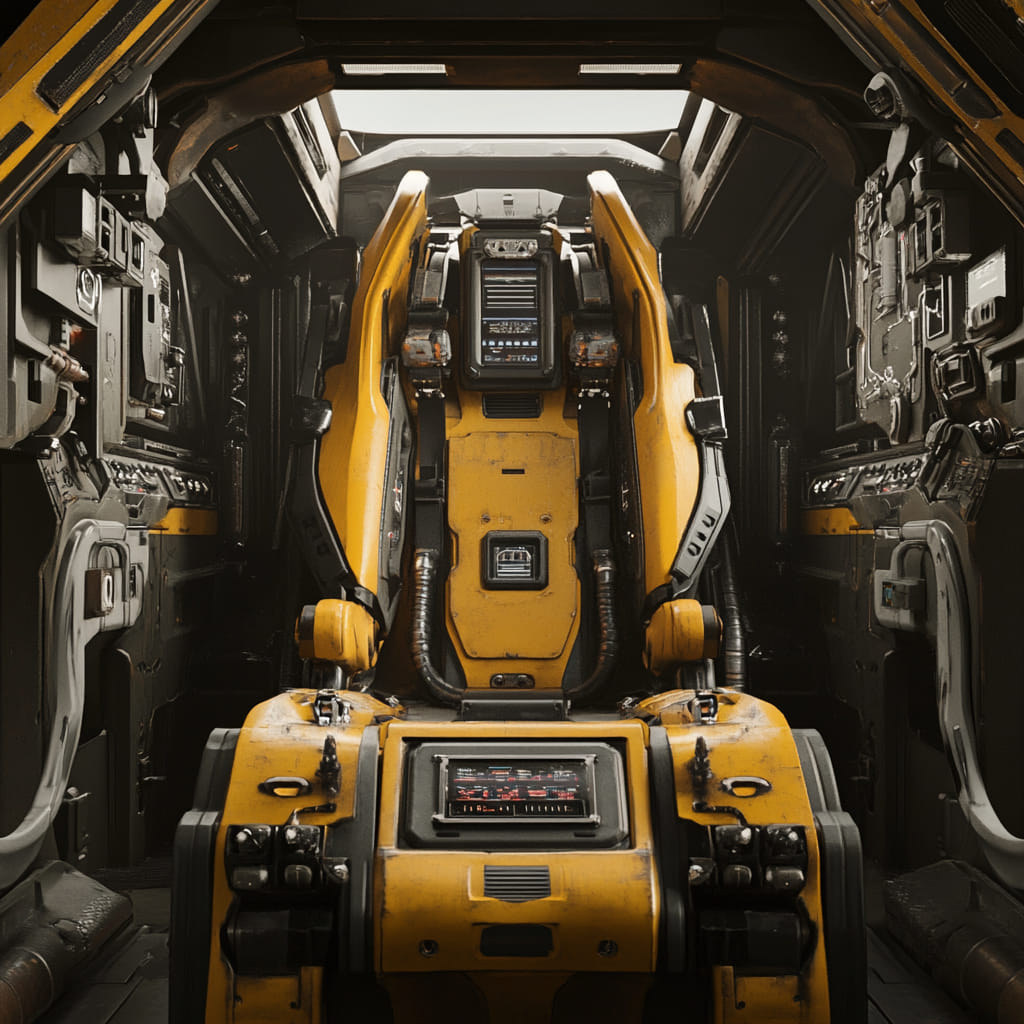
The "Zoom Backgrounds" meme describes the confusion of the background being empty when the focus is tight on the foreground object. It is like the background is trying to speak but can't find the words. Even though the image is packed with glowing screens and machinery, the user is stuck looking at a yellow chair, and the actual background remains dark and empty, resulting in a sudden, uninvited cut to a white void.
detailed-analysis (gemma3_27b-it-q8_0)
Okay, let's dissect this image, specifically as a potential Zoom background, through various theoretical lenses. It’s a striking, somewhat unsettling image, and the meaning shifts depending on how you look at it.
Visual Description
The image presents a first-person perspective inside a highly complex, futuristic cockpit or chair. The dominant color is a saturated, almost industrial yellow-orange, contrasted with dark grey/black and the bright white glow of an unseen window or light source at the top. The structure is densely packed with buttons, screens, and greebling (detailed, often non-functional additions to make something look more complex). There are armrests on either side, suggesting a seated position. The overall aesthetic leans towards science fiction, leaning into a feeling of claustrophobia, control, and technological immersion. The viewpoint itself is the key element; it mimics being inside the machine, rather than just seeing it. This impacts its usage as a Zoom background significantly.
Foucauldian Genealogical Discourse Analysis
As a Zoom background, this image actively participates in a discourse of power and surveillance. Michel Foucault would argue that power isn't just top-down, but is dispersed throughout society in 'discourses' – ways of talking, thinking, and behaving.
- Panopticism: The cockpit evokes the Panopticon, a prison design where guards could potentially observe all inmates without the inmates knowing if they are being watched at any given moment. The image, though not a prison, suggests a similar sense of being contained and potentially observed. When used in a Zoom call, the user is effectively presenting themselves within this surveillance architecture. It asks, “Who is watching me while I am communicating?”
- Discipline and Normalization: The highly technical, meticulously designed interior indicates a focus on control and efficiency. This aesthetic can be interpreted as reflecting societal pressures to be productive, optimized, and technologically integrated. Using this as a backdrop subtly reinforces this discourse.
- Genealogy of Control: Examining the history of similar imagery (sci-fi control panels, pilot seats, etc.) reveals a consistent association with authority, command, and technological dominance. The image doesn't originate in a vacuum; it draws on a long lineage of representing control.
Critical Theory
From a Critical Theory perspective, this image can be seen as a manifestation of the "instrumental reason" described by thinkers like Max Horkheimer and Theodor Adorno.
- Domination of Nature: The highly engineered, artificial environment embodies a desire to control and master nature through technology. The absence of natural elements reinforces this theme. The Zoom user, framed by this backdrop, might be subtly signalling their alignment with, or at least immersion in, this technocratic worldview.
- Reification: The objectification of the human experience – being reduced to a 'user' within a system – is present. The chair/cockpit isn't designed for comfort or individual expression; it's optimized for function. The user's presence is implied, but the focus is overwhelmingly on the machine.
- False Consciousness: Critically, using this as a background could mask the underlying power structures at play. The user might present an image of technological proficiency or sophistication, without acknowledging the socio-political implications of that technology.
Marxist Conflict Theory
From a Marxist standpoint, the image represents a visual embodiment of class relations and the control of the means of production.
- Alienation: The user "inside" the machine is alienated from their own agency, becoming a component of a larger technological system. The focus isn't on who is operating the controls but on the controls themselves.
- Technological Determinism: The image can be seen as promoting the idea that technology drives social change, rather than being shaped by social forces. This obscures the fact that technology is developed and controlled by specific groups (the owning class) with particular interests.
- Ideological Apparatus: The image functions as an "ideological apparatus" – a tool for reinforcing the dominant ideology of technological progress and control. By using it as a background, the user is, consciously or unconsciously, participating in the dissemination of this ideology.
Postmodernism
Postmodern thought would approach this image as a pastiche, a simulation, and a questioning of "reality."
- Hyperreality: The image isn't necessarily representing a real space; it’s a constructed simulation. It's a hyperreal version of a cockpit, exaggerated and stylized. The Zoom call itself is a mediated experience, adding another layer of simulation.
- Loss of Grand Narratives: The image doesn't offer a clear, unified meaning or purpose. There's no grand narrative of progress or liberation inherent in the design. It’s fragmented, ambiguous, and open to multiple interpretations.
- The Simulacrum & Simulation: Following Baudrillard, this could be seen as a simulacrum – a copy without an original. It's an imitation of a control space that lacks a genuine referent, existing purely as a sign.
Queer Feminist Intersectional Analysis
This image, while seemingly neutral, can be analyzed through a Queer Feminist Intersectional lens that considers how power operates based on multiple, intersecting identities.
- Masculine Coding: The design, with its angularity, dark colors, and association with control/technology, is heavily coded as masculine. This contributes to the erasure of other ways of relating to technology and power. Using this background can inadvertently reinforce these gendered power dynamics.
- Spatial Politics: The constricted space and sense of containment can be interpreted as symbolic of social constraints placed upon marginalized groups. The chair/cockpit becomes a metaphor for limited agency and social control.
- Accessibility & Embodiment: The design isn’t inherently inclusive. Consideration of how bodies with different abilities or needs might interact with this space is missing. The hyper-optimization for a specific "ideal" user reinforces exclusionary design practices. A user choosing this background may inadvertently be prioritizing and celebrating a vision of technology that excludes others.
In conclusion, this image, when viewed as a Zoom background, is far from neutral. It's a complex symbol loaded with cultural, political, and philosophical implications. The user's choice to employ it says something about their relationship to technology, power, and society, whether they're aware of it or not. It’s a conversation starter, and a visually interesting backdrop, but it's one that warrants a critical eye.
simple-description (llama3.2-vision_11b)
The meme is an image of a futuristic-looking, high-tech room with a large window that appears to be a zoomed-in view of a spaceship's control panel. The text in the image reads "Zoom Backgrounds". This meme is likely a humorous take on the common practice of using generic, futuristic-looking backgrounds in video conferencing software, poking fun at the idea that such backgrounds are often used to make a meeting or presentation seem more "high-tech" or exciting.
detailed-analysis (gemma3-27b-vision)
Okay, let's break down this image through several critical lenses.
Visual Description
The image depicts an interior of what appears to be a futuristic or science-fiction vehicle or station. The dominant color is a muted, slightly worn yellow-gold, covering a complex assemblage of mechanical components. The view is highly symmetrical, focusing on a chair or cockpit-like structure with articulated arms or robotic appendages extending on either side. The space is enclosed by a dark, metallic framework densely filled with pipes, conduits, and mechanical details, creating a claustrophobic, industrial aesthetic. There is a bright light source above the structure, possibly a window or hatch, providing a dramatic contrast between illumination and shadow. The overall impression is one of advanced technology, perhaps in a state of disrepair or abandonment. The design speaks of functionality and ruggedness over elegance. The focus is on the mechanics of the device, showcasing a complex and potentially intimidating internal structure.
Foucauldian Genealogical Discourse Analysis
The image immediately evokes a sense of discipline and control. The chair/cockpit, the complex array of robotic arms, and the tightly enclosed space speak to a system designed for containing and directing a body. Following Foucault, we can see this not as merely a functional machine, but as an apparatus – a complex of discourses, institutions, architectural arrangements, and technologies that produce specific subjectivities.
- Discipline: The design clearly dictates posture and movement. It is a machine designed to shape a body – likely a pilot or operator – into a specific, optimized form.
- Surveillance: The arrangement suggests a degree of observation. While not explicitly visible, the intricacy of the controls and the tight enclosure imply that the operator's actions are monitored and controlled.
- Genealogy: A genealogical analysis would investigate the historical development of this technology. What prior technologies or social practices informed this design? What ideas about efficiency, control, and the human body are embedded within it? The wear and tear on the machine suggest a history of use, but also potentially of resistance or adaptation. It is a product of a lineage of technological and social forces.
Critical Theory
Drawing from the Frankfurt School, particularly thinkers like Adorno and Horkheimer, we can see in this image a reflection of the instrumental reason of modern technology. The machine is designed for a specific purpose – presumably control or operation – and everything is optimized for that end, stripping away any aesthetic or humanistic considerations.
- The Technological Imperative: The image embodies the belief that technology develops according to its own internal logic, regardless of human needs or consequences. This machine is its function, and its aesthetic is dictated by efficiency, not beauty.
- Alienation: The image conveys a sense of detachment and alienation. The human operator, if present, would be enveloped by this cold, mechanical environment, potentially losing a sense of connection to the world or to their own agency.
- Domination of Nature: The machine represents a mastery over nature, a transformation of materials into a tool for human (or perhaps non-human) purposes.
Marxist Conflict Theory
From a Marxist perspective, the image could be interpreted as a symbol of class power and exploitation. Who owns and controls this technology? Who benefits from its use?
- Means of Production: This machine is a means of production, a tool used to create value or exert control. The ownership of this machine would be crucial in determining the power dynamics within its context.
- Alienated Labor: If used by a worker, this machine could embody alienated labor. The worker is separated from the fruits of their labor, reduced to a mere cog in the machine, and subjected to the demands of the technology and its owners.
- Control and Surveillance: The enclosed, controlled environment could be seen as a metaphor for the oppressive structures of capitalism, where individuals are constantly monitored and subjected to control.
Postmodernism
A postmodern reading of the image would emphasize its fragmentation and lack of overarching meaning. The dense, complex array of mechanical components resists a singular interpretation.
- Simulation and Hyperreality: The machine could be seen as a simulation – a copy without an original. It represents a constructed reality, divorced from any natural or authentic foundation.
- Deconstruction: A deconstructive reading would highlight the contradictions and ambiguities within the image. The machine is designed for control, but its complexity and potential for malfunction also suggest a loss of control.
- Loss of Grand Narratives: The image lacks any clear narrative or purpose. It is a fragment of a larger system, disconnected from any overarching ideological framework.
Queer Feminist Intersectional Analysis
This is the most challenging lens to apply directly without further context, but it’s still possible. We can look at the power dynamics implied by the machine’s design.
- Gendering of Technology: Historically, technology has often been presented as masculine – associated with control, power, and dominance. This machine’s cold, mechanical aesthetic reinforces that gendering.
- Body/Machine Interface: The tight, confining space and the robotic appendages raise questions about the relationship between the body and technology. Who is designed to fit into this machine? Whose bodies are marginalized or excluded? The machine seems to require a specific body to operate, enacting control.
- Power Dynamics: Considering the potential for control implied in the design, this machine could represent a mechanism of oppression, particularly for marginalized groups. Who benefits from this control, and who is subjected to it? The intersection of gender, race, class, and other identity markers would be crucial to understanding the power dynamics at play.
It is important to note that these are just interpretations. The image is open to multiple readings, and its meaning will depend on the viewer’s own background, experiences, and theoretical framework.
simple-description (llama3.2-vision)
This meme is a picture of a futuristic, high-tech, and very expensive chair, specifically the "Mega-Seat" from the video game "Destiny 2". The chair is designed to be an "executive" chair, complete with a "HOLY F***ING . . . . . . . . . . . . . . . . . . . . . . . . . . . . . . . . . .